I build Professional Services, PMO, and customer delivery organizations that make companies easier to scale, easier for customers to trust, and better positioned to grow. Twenty-plus years across AI-enabled SaaS, software integrations, energy infrastructure, data centers, manufacturing, and defense.
I'm JJ. I get brought in when delivery is breaking down, when handoffs are falling apart, when margins are leaking, and when executives can't get a clean read on what their teams are actually doing.
When something is failing, the fastest fix is almost never more bodies. The real failure is usually structural: unclear roles, misaligned incentives, or a handoff process that was inadvertently designed to fail. With this philosophy in mind, I have transformed delivery for organizations like TE Connectivity, Motorola Solutions, Real Items, and the Department of Defense.
The Delivery Shark is the brand. The work is the proof. Since 2021 I have also been an underwater photographer based in Florida, shooting sharks in their actual environment as @Sharkography on Instagram.
Most companies treat a signed contract as the finish line and delivery as a cost center. I treat it as our one shot to maximize customer lifetime value. Cost of new client acquisition is high, cost of keeping existing clients is low. Consistent delivery execution is the glue that holds it all together.
I diagnose the system before the people. I name the function. I engage every stakeholder in the process: VPs, sales, operations, procurement, production, shipping, factory floor. I measure stakes in twenty-year customer relationships, not stakeholder dashboards.
Repositioned the install business at Motorola/Envysion from cost center to self-funding revenue unit, directly contributing to record expansion across current customers.
Influenced margin expansion and forecasting discipline across a delivery organization that scaled annual recurring revenue from $10M to $70M.
Walked a daily-escalation customer back to trust by aligning the VP, factory floor, planning, procurement, production, and shipping around a single customer-first goal.
Each one-pager follows the same arc: the situation, the system diagnosis, the message walked through the org, and the result. No "stakeholders." Names of functions. Dollar figures or year horizons, where the truth supports them.
Situation
I joined a daily escalation call with the directors and VPs of a 20-year customer in the energy and data center solutions business. The delivery was scheduled three weeks early, and I asked the room why an escalation call was still running. The customer's senior VP came on the line and answered the question directly: they had no trust that we would do what we said we would do.
System Diagnosis
The problem was alignment. Pre-contract readiness was not validating scope, lead times, sourcing plans, or logistics assumptions before execution inherited the consequences. Gray-area decisions were falling between teams because nobody owned them. Functional KPIs were competing against the customer commitment.
Walked the Message
I walked that message personally across the org, function by function, from our VP down to Sales, Planning, Procurement, Production, Shipping, and the factory floor loading the boxes. I made the customer reality impossible to ignore: we were not aligned, we had lost trust, and a 20-year relationship was at stake, backward and forward. Once a new supplier was in place, that business was gone for the next 20 years too.
Action
Pre-contract readiness governance so scope, lead times, sourcing plans, and logistics assumptions were validated before execution inherited the consequences. RACIs and clearer decision ownership across the gray areas where issues had been falling between teams. A single customer-first goal that competing KPIs were realigned around.
Trust returned. I walked the win back through the org a second time, VP to factory floor, so every function could see what they had changed had landed with the customer. The 20-year relationship held.

Situation
The install operation was losing 8% per install. Leadership treated installation as a cost of winning recurring revenue. Some installs were priced too low, scoped too loosely, supported too poorly. The business was leaving money on the table while training customers that expert work was free.
System Diagnosis
Installation was not a pricing problem. It was an operating model that gave away expertise without defining boundaries. Quoting varied by who answered the phone. Site readiness lived in tribal knowledge. Field partners billed by the hour because routine work had no standard scope. The cheapest hardware was usually expensive once revisits were counted.
Walked the Message
I walked the customer reality through Sales, Solutions Consulting, Finance, and the field. Install was not a back-office line item. It was the first physical proof the customer made the right decision. A bad install did not just cost margin. It cost the next ten sites.
Action
Productized install offerings with flat-rate scopes, standardized readiness checks, and partner-input scoping. Tied install quality to expansion strategy and rollout conversion. Made margin drivers visible during delivery, not after closeout. Installation became a service customers could understand and the business could repeat.
Install margin moved from 8% to 50%. The function became self-funding. Sales stopped treating install as a discount lever. Customers started treating the first site as proof the rollout could be trusted.
Situation
Sales and Customer Success were paid against incentive structures that quietly competed. When customers transferred sites between accounts, both teams had a reason to shape the outcome around their own scoreboard. The work still got done. The customer was not the one being optimized for.
System Diagnosis
Nobody was behaving badly. The villain was structural. Commission design rewarded the move that was easiest to claim, not the move that was best for the customer. Site-transfer games were the predictable consequence of an incentive split that two departments had been asked to live inside.
Walked the Message
I walked the customer impact through Sales, Customer Success, Finance, and Operations. Procurement could save money on the wrong component. Production could ship to its own schedule. Sales could close a deal with assumptions no one could deliver. Each team could defend its choices, and the customer only saw one company missing one promise.
Action
Realigned the incentive design so site-transfer behavior had to pass a customer-first filter before either team could claim credit. Made internal tradeoffs visible against shared customer commitments. Treated the commission structure as the operating system it actually was.
Site-transfer behavior stopped competing against the customer outcome. The company stopped paying for chaos by the hour and started paying for the move that protected the relationship.
Situation
A customer wanted a new analytics capability that looked promising but carried delivery and adoption risk. The temptation was to sell the full rollout immediately. The capability had not been proven at scale, and an overpromise would turn the customer into a test environment with a purchase order.
System Diagnosis
A free pilot would become unpaid implementation with no decision path. Vague success criteria would let the work drift. The customer needed evidence, not enthusiasm, and the business needed a way to learn at controlled cost before scaling a commitment.
Walked the Message
I walked the pilot question through Sales, Product, Professional Services, and the customer sponsor. The pilot would not be a science project. It would be a structured experiment with a defined hypothesis, scope, timeline, customer responsibilities, success measures, and a real exit path.
Action
Defined the pilot hypothesis before defining the pilot plan. Limited scope to what had to be proven. Designed expansion logic so a successful pattern became a repeatable packaged offering, not a one-off favor. Customers will tolerate iteration. What breaks trust is being sold certainty before the solution has earned it.
The pilot produced evidence, not hype. The customer got a stronger business case for expansion. The capability became a packaged service the company could sell, deliver, measure, and improve.
Situation
Projects were launching successfully from a technical standpoint, and adoption varied widely. Customer Success was inheriting a problem that was designed into the implementation months earlier. Some launches focused too heavily on configuration and too lightly on the behavior change the customer actually purchased.
System Diagnosis
Adoption was not a Customer Success problem alone. It was shaped by scoping, design, configuration, training, workflow fit, executive sponsorship, and user readiness. If those pieces were weak, CS would inherit a problem nobody else had agreed to own.
Walked the Message
I walked the value-realization message through Product, Professional Services, Customer Success, Sales, and the customer-side admin owners. Go-live was not the finish line. It was the moment the customer started proving whether the solution mattered to their day.
Action
Built adoption requirements into discovery and kickoff: user groups, training needs, workflow changes, admin ownership, launch communications, success measures, and post-go-live reinforcement. Made early value milestones visible to the customer and the team. Tracked usage and value after launch, not just configuration completeness.
Technical launch became one part of a broader success plan. Renewal conversations turned on outcomes, not invoices. Platform stickiness stopped depending on customer effort and started depending on the delivery design.
Align. Execute. Deliver. Grow.
Sink or Scale is the operating philosophy behind every delivery turnaround I have walked into. How to align an organization around one customer-first truth, where margin actually leaks, why delivery is the place a sale becomes a twenty-year customer, and what changes when Professional Services stops apologizing for existing. Built for leaders who are tired of treating Professional Services like a post-sale utility closet.
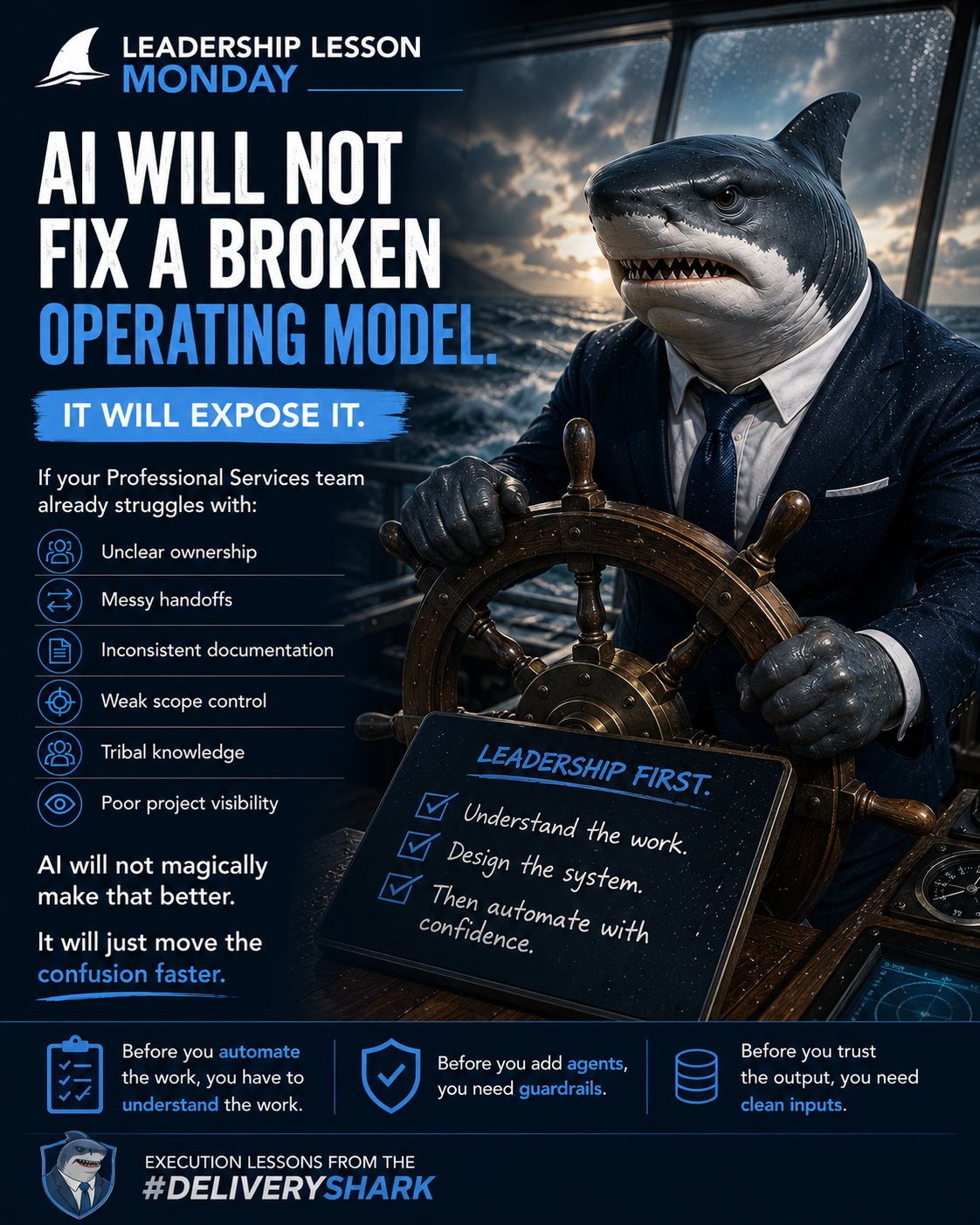
AI will not fix a broken operating model. It will expose it.
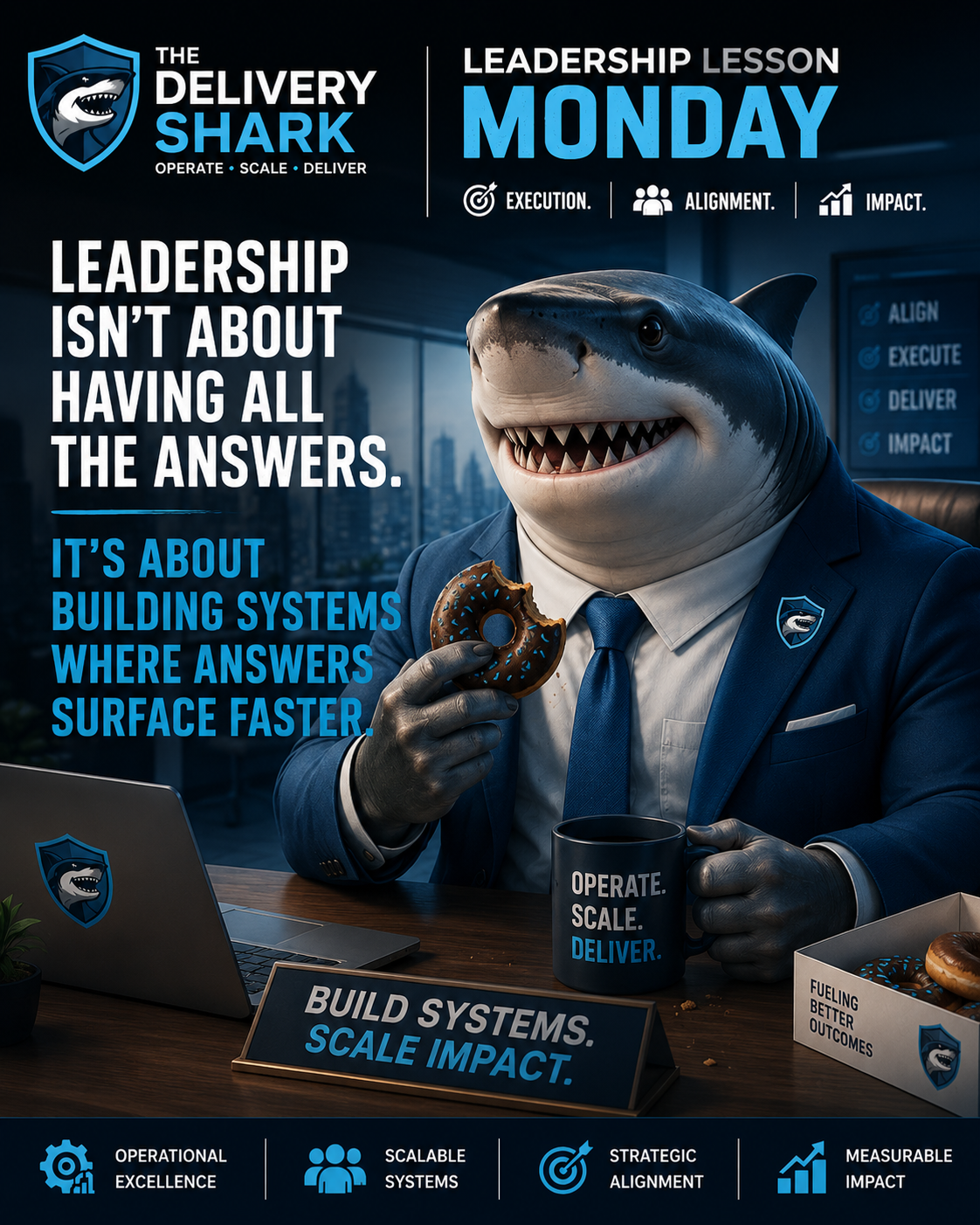
Leadership isn't about having all the answers. It's about building systems where answers surface faster.
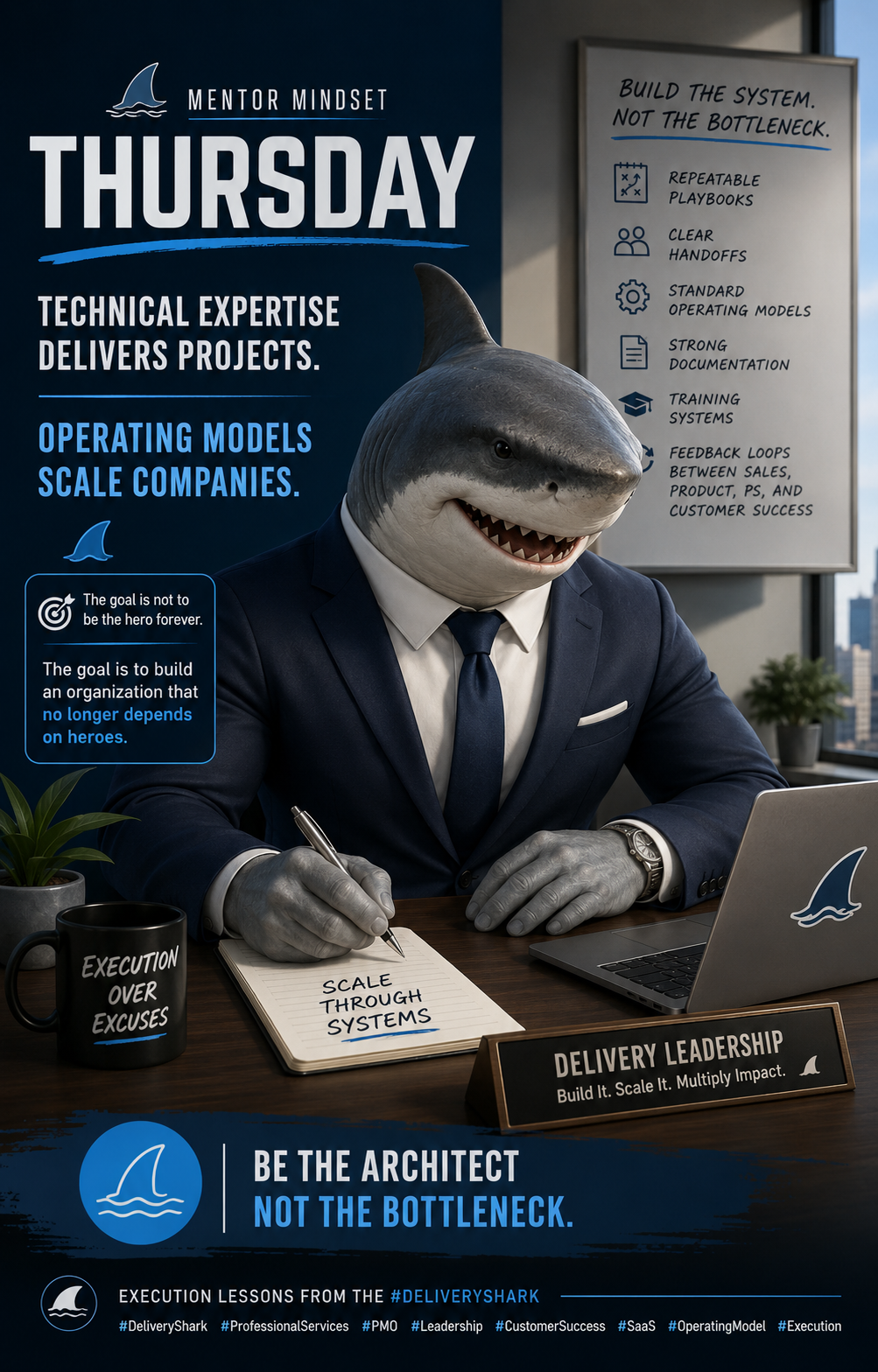
The goal is not to be the hero forever. The goal is to build an organization that no longer depends on heroes.
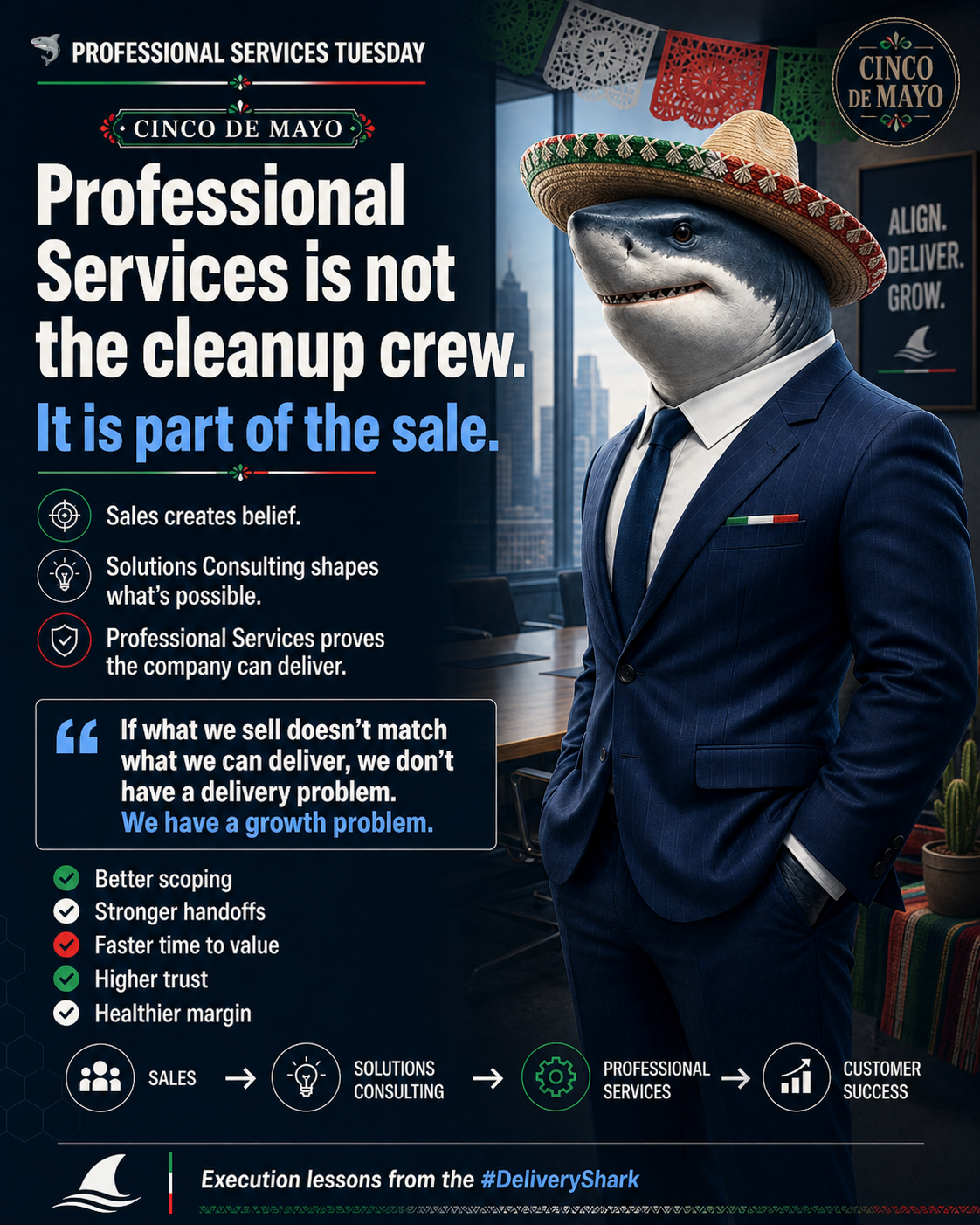
Professional Services is not the cleanup crew. It is part of the sale.
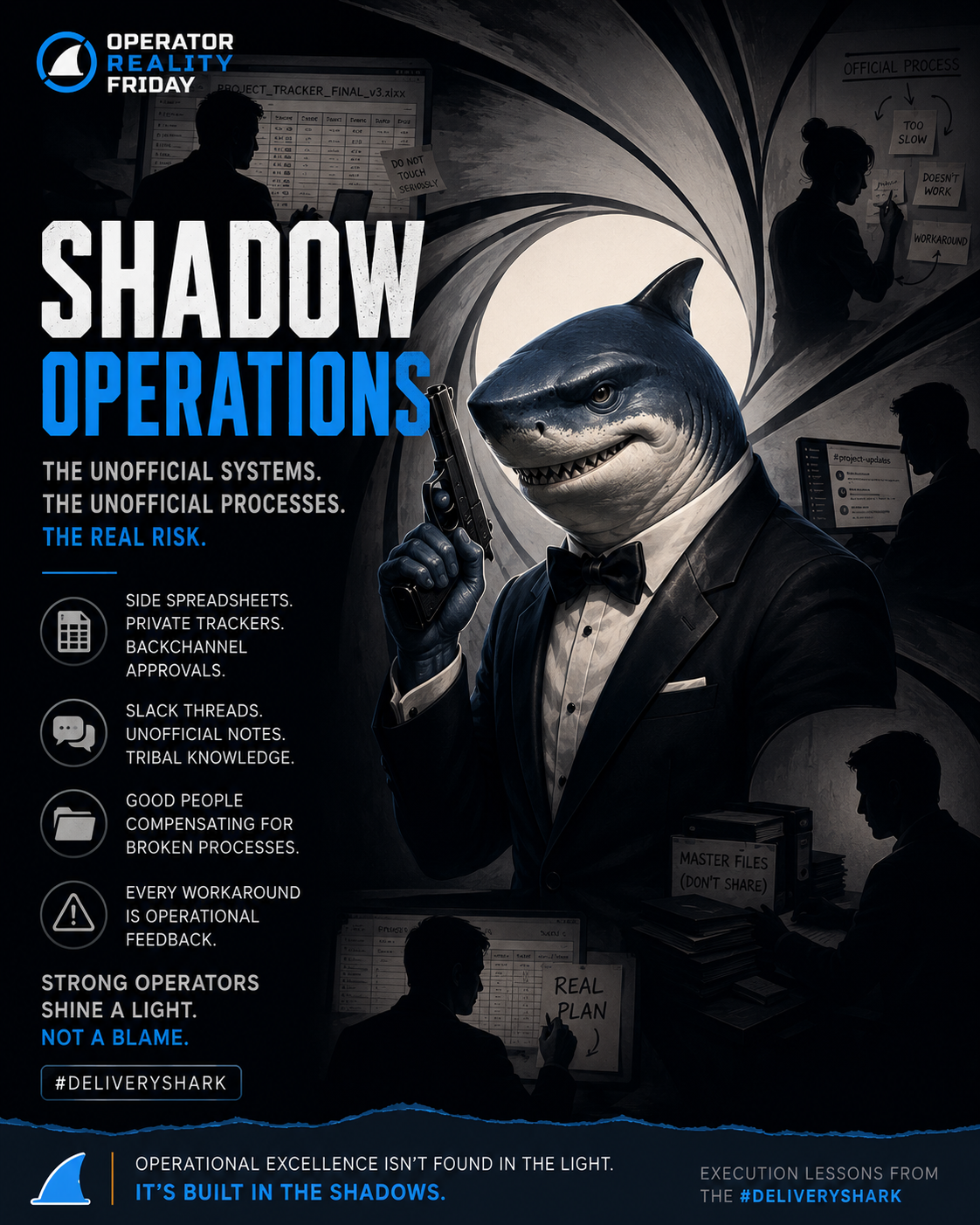
Shadow operations. The unofficial systems. The unofficial processes. The real risk.
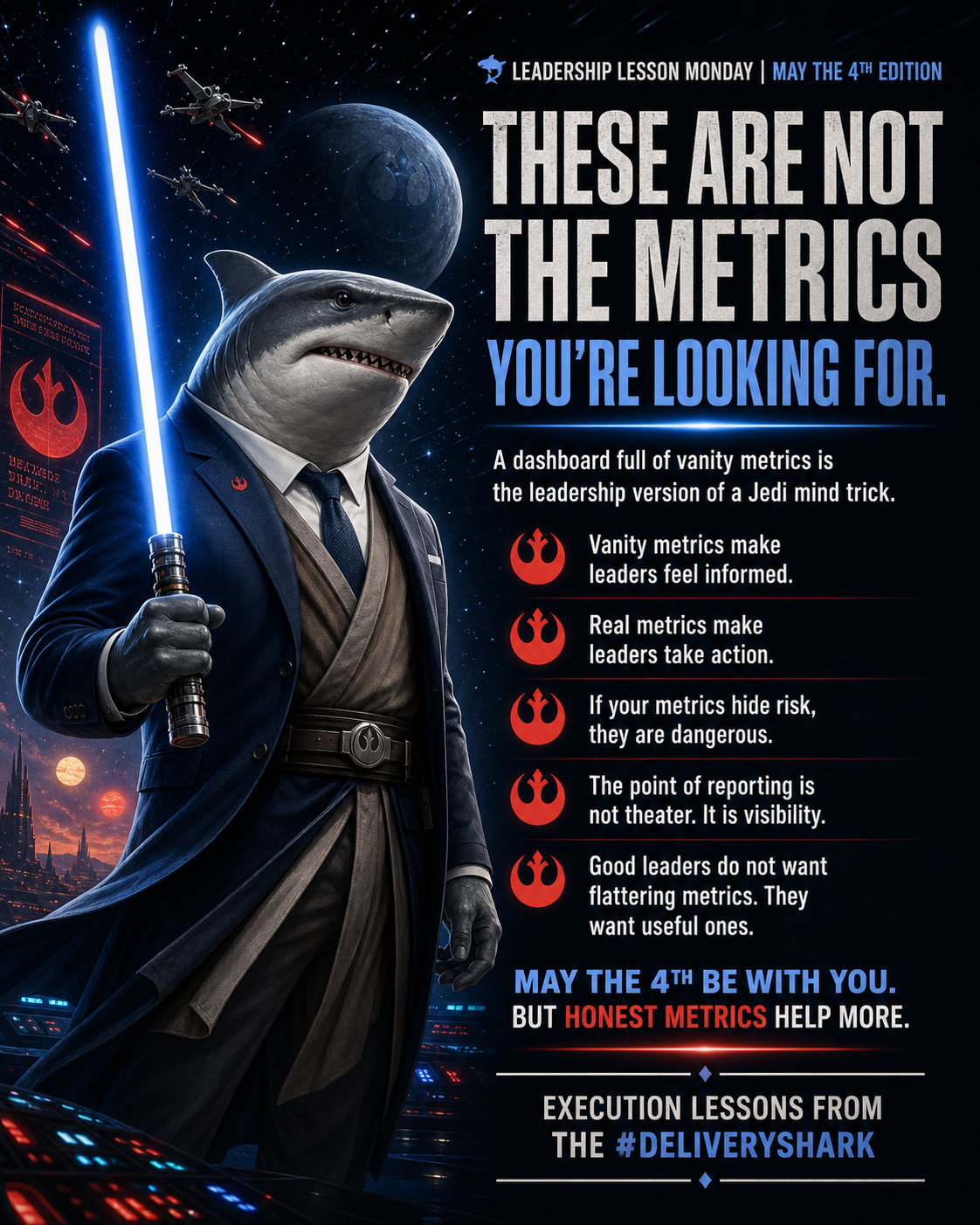
A dashboard full of vanity metrics is the leadership version of a Jedi mind trick.
Founder & Principal
Delivery Shark · Professional Leadership
Senior Manager, Project Management — Professional Services, Energy Americas
TE Connectivity
Senior Program / Project Manager — Solutions Delivery, Professional Services
Motorola Solutions / Envysion
Operations Executive
Real Items
Senior Program Manager
Department of Defense · U.S. Army, Picatinny Arsenal
Owner & Photographer
Sharkography · Florida
Underwater shark photography. Real practice, real sharks, real water. Follow at @Sharkography.
M.S., Information Technology · B.B.A., Economics & Computer Information Systems
Stevens Institute of Technology (2005–2007) · University of Miami (2000–2003)
Recruiters, hiring leaders, and industry enthusiasts welcome. I reply within a day.